



As organizations begin planning investments for the year ahead, warehouse leaders may be evaluating new equipment, storage changes, automation and other opportunities to improve performance. But before deciding where to invest, there is a more fundamental question to answer: What does the operation actually need?
In a recent Forbes article titled The Biggest Automation Mistake Material Handling Leaders Make and How to Avoid It, Carolina Handling Chief Operating Officer Joe Perkins argues that companies considering automation should resist the temptation to jump directly to technology, and instead ensure they optimize before automating.
Whether an organization is considering a different forklift, a new storage strategy, or a larger technology investment, leaders need to understand current operating conditions before determining what comes next. As planning begins for another calendar year, now is a good time to dig into the data.
How Can Warehouse Leaders Optimize Before They Invest?
Material handling leaders make decisions about equipment, storage, labor, and workflows every day. But without understanding those conditions, organizations risk investing before fully defining the problems they need to solve. That understanding is particularly important when automation enters the conversation.
In the Forbes article, Perkins argues that automation and optimization are not the same thing. He said processes first need to be understood, and existing problems must be addressed. Otherwise, organizations risk carrying inefficiencies into newly automated workflows.
“If you automate the documented process rather than the real one, there’s a good chance you've automated a fiction,” Perkins said.
His recommendation is to understand how work actually happens on the floor, talk with the people who perform it, and apply a lean lens before a technology budget. For leaders looking ahead to next year's investments, the recommended steps are:
-
Understand the operation.
-
Identify the problem.
-
Optimize the process.
-
Determine where investments make sense.
What Should Warehouse Leaders Evaluate Before Making Capital Investments?
The first step is establishing a baseline. For example, before changing equipment, leaders need to understand the current cost of operation. Before changing storage strategies, they need to understand how inventory moves through the facility. And, before automating a process, they need to understand how that process actually works.
Carolina Handling has created two online calculators that can help organizations answer important questions using information from their own operations:
While the calculators address two different areas of warehouse performance, both provide a data-backed starting point for evaluating operational decisions. The goal is to give leaders better information before they make investment decisions.
What Is Your Forklift Fleet Really Costing You?
When organizations evaluate material handling equipment, purchase price naturally receives significant attention. But acquisition cost is only part of the equation. The cost of operating a forklift fleet can also include:
-
Fuel or energy consumption
-
Maintenance requirements
-
Labor costs
-
Annual operating hours
-
Equipment utilization
Looking beyond purchase price provides a more complete view of an equipment investment. Understanding these variables can help organizations evaluate long-term operating costs, identify opportunities for cost reduction and build stronger business cases for future equipment investments.
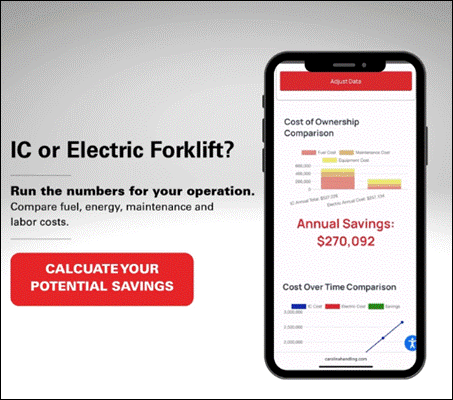
Carolina Handling's IC vs. Electric Forklift Cost Savings Calculator supports that evaluation by allowing organizations to compare internal combustion and electric forklifts using operational information from their own facilities. The calculator examines costs associated with fuel or energy usage, maintenance, and labor, helping leaders better understand the long-term financial implications of their equipment choices.
For some operations, internal combustion forklifts may continue to make sense based on application requirements. For others, the data may identify opportunities to reduce operating costs through using electric forklifts. The goal is to give leaders a clearer, data-backed starting point for determining which option makes sense for their operation. That approach also reflects a broader point from Perkins' Forbes article, which is to understand the operation before committing to a solution. When considering automation, he recommends that leaders ask:
“Have we engaged the people who actually do this work? Have we tested our assumptions against reality? Does the automation support our customer commitments, or are we letting it define them? If those questions don't have solid answers, it's worth pressing pause.”
Applied more broadly to year-end equipment planning, the principle is the same: understand the problem, test assumptions against operational data, and then determine where investment makes sense.
How Does Better Inventory Placement Improve Warehouse Performance?
Warehouse performance is also influenced by where inventory is positioned throughout the facility.
Carolina Handling's Pareto Storage Calculator helps organizations evaluate inventory distribution based on SKU velocity, pallet demand, and storage requirements. Using those inputs, the calculator provides insights into how inventory can be grouped and positioned to support more efficient warehouse operations.
The analysis can help warehouse leaders examine:
- Which SKUs drive the most activity
- Where fast-moving inventory should be stored
- Opportunities to reduce travel time
- Ways to improve space utilization
- Strategies for balancing accessibility and storage density
Rather than assuming the current layout is the right one because it has worked in the past, organizations can evaluate whether storage decisions align with current demand patterns. That distinction matters when leaders are considering larger investments.
A perceived capacity, productivity, or material flow problem may require investment, but understanding how the operation uses its existing space and resources provides a stronger starting point for determining what that investment should be.
What Does “Optimize Before You Automate” Look Like in Practice?
Applying a “lean lens before a technology budget” means identifying and eliminating unnecessary steps, redundant handling, overprocessing and other sources of waste before investing in automation. Perkins said organizations going through this process may discover that they do not need as much automation as originally anticipated, or that the actual need differs from their initial assumption.
That same type of evaluation can be applied to other warehouse investments. For example, before changing the fleet, it’s critical to understand its operating costs. Before redesigning storage, leaders must understand inventory velocity and demand. And, before automating a process, warehouse leaders need to see how the work is actually performed. Once that groundwork has been done, leaders are in a better position to evaluate what comes next.
What Questions Should Warehouse Leaders Ask When Planning for Next Year?
Year-end planning often brings equipment, technology, and other operational investments into focus. Before committing resources, leaders can use the planning process to take a closer look at both the problem and the proposed solution.
Before asking, “What should we buy?” Perkins said leaders should first ask, “What problem are we trying to solve, and does our data support this investment?”
For broader warehouse planning, leaders can also ask:
- Do we understand what our equipment actually costs to operate?
- Are we making equipment decisions based primarily on acquisition price or are we considering longer-term operating costs?
- Does inventory placement reflect current SKU velocity and demand?
- Are unnecessary travel, handling, or process steps affecting productivity?
- Have we clearly defined the operational problem an investment is intended to solve?
- Have we examined the existing process before deciding that technology is the answer?
The objective should be to determine where investment can address a clearly understood operational need.
When Is It Time to Move Forward With Automation?
Optimizing first does not mean delaying investment indefinitely. Perkins said that waiting can carry its own risks when labor challenges cannot be addressed through recruiting alone, and operational demands require another solution.
Once an organization understands the process, eliminates unnecessary waste, challenges its assumptions, and determines that automation supports its operational and customer needs, it may be the right decision to move forward with automation.
“The strongest automation strategies are built on optimized processes,” Perkins said.
He said that is an important distinction for leaders heading into another planning cycle.
Next Year's Planning With This Year's Operation
Looking ahead is an important part of capital planning, but some of the most useful information for next year's decisions already exist inside today's operation.
Here are some important questions to ask:
-
How much does it cost to operate the fleet?
-
How is inventory moving through the building?
-
Where are associates spending unnecessary time?
-
Which processes contain waste?
-
What problem would a proposed investment actually solve?
Carolina Handling's IC vs. Electric Forklift Cost Savings Calculator and Pareto Storage Calculator provide two practical ways to begin examining those questions with operational data.
The results and numbers can be the starting point for the decision-making process. Whether the eventual answer is different equipment, a new storage strategy, process improvement, or automation, the order matters: Understand first, optimize second, invest third.
Ready to evaluate your operation?
Use Carolina Handling's calculators as you plan for the year ahead. If the results identify questions or opportunities worth exploring further, Carolina Handling can help evaluate your operation, identify opportunities, and prioritize your investments.
Frequently Asked Questions
What does “optimize before you automate” mean?
Short answer: “Optimize before you automate” means understanding and improving a process before introducing automation. In a Forbes article, Joe Perkins recommends examining how work actually occurs, engaging the people performing it, and eliminating unnecessary steps or waste before determining how automation should be applied.
What should warehouse leaders evaluate before making a capital investment?
Short answer: The appropriate considerations depend on the investment, but leaders can begin by defining the operational problem they are trying to solve and establishing a baseline. For equipment decisions, that can include factors such as fuel or energy consumption, maintenance, labor, operating hours and equipment utilization. For storage decisions, SKU velocity, pallet demand and storage requirements can provide useful context.
What is the IC vs. Electric Forklift Cost Savings Calculator?
Short answer: Carolina Handling's IC vs. Electric Forklift Cost Savings Calculator is a tool that compares internal combustion and electric forklifts using operational information including fuel or energy usage, maintenance, and labor.
What factors should you consider when choosing between an electric and internal combustion forklift?
Short answer: Application requirements matter, and operating costs such as fuel or energy use, maintenance and labor can affect the long-term financial picture. Carolina Handling’s IC vs. Electric Forklift Cost Savings Calculator can help you evaluate options based on your actual operating conditions rather than assumptions.
How does Carolina Handling’s Pareto Storage Calculator work?
Carolina Handling's Pareto Storage Calculator uses SKU velocity, pallet demand and storage requirements to help organizations evaluate inventory distribution and identify opportunities related to inventory placement, travel, and space utilization.