



Many warehouse and distribution operations are currently facing limited space, while ongoing labor constraints continue to put pressure on productivity and efficiency.
As a result, organizations are rethinking how they store, manage, and pick inventory. To address labor shortages or improve efficiency, companies are increasingly turning to automation. Solutions such as automated storage and retrieval systems (ASRS), including vertical lift modules, are helping operations overcome these issues and improve performance.
Why Are More Warehouses Investing in Warehouse Automation?
The need to move more goods with fewer resources is accelerating the adoption of warehouse automation.
Many organizations that previously viewed automation as too expensive are now reevaluating that assumption. As warehouse space becomes more costly and harder to secure, solutions that maximize existing footprints are becoming essential.
This shift is especially evident in operations that share several common characteristics:
- High volumes of small parts or components
- Limited floor space or growing space constraints
- Large SKU counts that are difficult to manage
- Inefficient picking processes that require excessive travel time
- Continued reliance on shelving, racking, bins, or manual parts rooms
These challenges are exactly where vertical lift modules deliver measurable value.
What Is a Vertical Lift Module and How Does It Work?
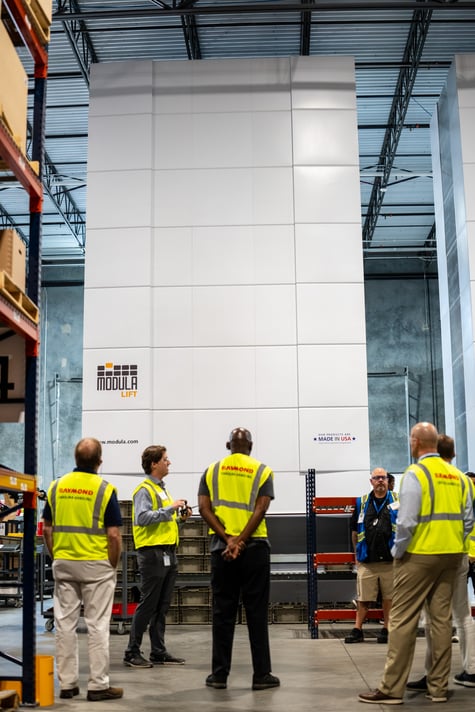
A vertical lift module, or VLM, is an automated vertical storage system that delivers goods directly to an operator at a workstation.
Instead of workers walking through aisles, climbing ladders, or searching for items, the system retrieves stored inventory from trays and presents it at an ergonomic height. This goods-to-person approach reduces travel time and streamlines picking.
VLMs also integrate with systems such as ERP, WMS, and DMS platforms, providing real-time inventory visibility and control.
What Are the Main Benefits of Vertical Lift Modules for Warehouses?
1. Maximize Space Utilization
Warehouse space is one of the most expensive and limited resources in any facility. Vertical lift modules address this challenge by building up instead of out.
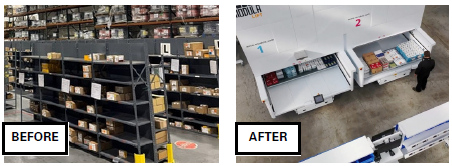
A VLM can compress up to 9,050 square feet of traditional shelving into a footprint of approximately 150 square feet while utilizing vertical ceiling height.
This allows organizations to:
- Reclaim valuable floor space
- Delay or eliminate facility expansion
- Consolidate multiple storage zones into a single system
Many warehouses that rely on shelving, racking, or bin storage find they are underutilizing vertical space. A high-density storage system transforms that unused air space into productive storage capacity.
2. Improve Pick Accuracy and Inventory Control
Picking errors remain a costly issue for distribution operations. The average mispick can cost up to $100, and many facilities still experience thousands of errors annually.
Vertical lift modules improve accuracy by:
- Using light-directed or guided picking systems
- Delivering the correct item directly to the operator
- Reducing manual handling and search time
- Providing real-time inventory tracking and traceability
Because inventory is stored inside an enclosed system, it is also protected from dust, damage, and unauthorized access.
The result is better order accuracy, improved customer satisfaction, and reduced operational costs.
3. Increase Productivity While Reducing Labor Strain
Labor shortages continue to impact warehouse operations across industries. At the same time, repetitive picking tasks can lead to fatigue, inefficiency, and safety risks.
Vertical lift modules address both challenges by improving workflow and ergonomics.
Key benefits include:
- Reduced walking, bending, and reaching
- Faster picking speeds with goods delivered to the operator
- Increased throughput without adding labor
- Safer, more ergonomic work environments
Advanced systems can significantly increase workforce productivity, with some operations achieving substantial gains in efficiency and throughput.
Automation does not replace workers. Instead, it allows them to focus on higher-value tasks while reducing the physical strain associated with manual picking.
What Types of Warehouses Benefit Most from Vertical Lift Modules?
Vertical lift modules are especially effective in environments such as:
- Manufacturing and automotive parts distribution
- Pharmaceutical and clean environments
- High-SKU warehouses with space constraints
- Operations relying on tote-based or bin storage systems
- Facilities using manual parts rooms or static shelving
These environments often share the same pain points: limited space, inefficient picking, and difficulty managing large numbers of SKUs.
How Can Vertical Lift Modules Deliver Value Even When Not Everything Fits?
A vertical lift module can still create meaningful value even when only part of a customer’s inventory is a fit.
“For example, if 80 percent of SKUs fit well in the vertical lift module, those items can be stored, picked, and consolidated much more effectively, while the remaining items are staged nearby where operators can still pick from the VLM and then batch together with those larger parts. In doing so, they're able to consolidate in a more effective way, pick more effectively, and store more effectively,” said Nick Romyns, Intralogistics Solutions Manager at Carolina Handling.
Can Vertical Lift Modules Help Warehouses Grow Without Expanding?
One of the most compelling advantages of vertical lift modules is their ability to support growth without requiring additional facility space.
By increasing storage density and improving picking efficiency, organizations can:
- Handle increased inventory volumes
- Improve order fulfillment speed
- Reduce reliance on additional labor
- Optimize existing warehouse footprints
In many cases, companies are able to avoid costly expansion projects and achieve a faster return on investment through labor and space savings.
How Do You Know If a Vertical Lift Module Is Right for Your Warehouse?
If your operation is experiencing space constraints, struggling with picking efficiency, or managing a growing number of SKUs, a vertical lift module may be the right solution.
Start by evaluating your current environment:
- Are you running out of space due to shelving or racking?
- Are workers spending too much time walking to pick items?
- Are picking errors impacting customer satisfaction?
- Are labor challenges limiting your ability to scale?
If the answer to any of these questions is yes, it may be time to explore an automated storage solution.
As an authorized Modula dealer since 2021, Carolina Handling has earned top-performer recognition from Modula, including Top Performer of the Year and Gold-level marketing recognition.
Frequently Asked Questions
Why are more warehouses investing in warehouse automation?
Short answer: More operations are trying to move more goods with fewer resources while dealing with space constraints, labor pressure, and inefficient manual processes.
What is a vertical lift module and how does it work?
Short answer: A vertical lift module is an automated vertical storage system that brings goods directly to an operator, reducing travel time and improving picking efficiency.
What are the main benefits of a vertical lift module?
Short answer: Vertical lift modules help maximize space, improve pick accuracy and inventory control, and increase productivity while reducing physical strain on workers.
What types of warehouses benefit most from vertical lift modules?
Short answer: They are especially valuable in operations with high SKU counts, limited space, small parts storage needs, and inefficient manual picking processes.
Can a vertical lift module help a warehouse grow without adding space?
Short answer: Yes. By increasing storage density and improving picking efficiency, a vertical lift module can help operations handle more inventory and throughput within the existing footprint.
How do you know if a vertical lift module is right for your warehouse?
Short answer: It may be a good fit if your operation is running out of space, struggling with picking efficiency, managing a growing number of SKUs, or facing labor-related constraints.
What Should You Do Next If You Are Considering a Vertical Lift Module?
Short answer: Vertical lift modules are helping organizations across industries reclaim space, improve accuracy, and increase productivity without expanding their footprint. To see how much space you could save and how automation could transform your operation, connect with an intralogistics expert to evaluate your facility and identify the best-fit solution.