



When warehouse leaders evaluate forklift purchases, the first question is often whether to buy a new or used forklift.
Organizations must balance equipment uptime, production requirements, operating costs, and capital priorities. Some organizations need equipment that can support demanding, multi-shift operations, while others need a dependable forklift for a single shift, seasonal demand, or backup capacity.
The challenge is that not every used forklift offers the same level of refurbishment, warranty protection, or long-term value. Recognizing those differences, Carolina Handling has expanded its Renewed Forklift Program with three clearly defined tiers of professionally refurbished equipment: Premier, Advantage and Basics. The expanded program gives customers more options based on application, utilization, and investment considerations.
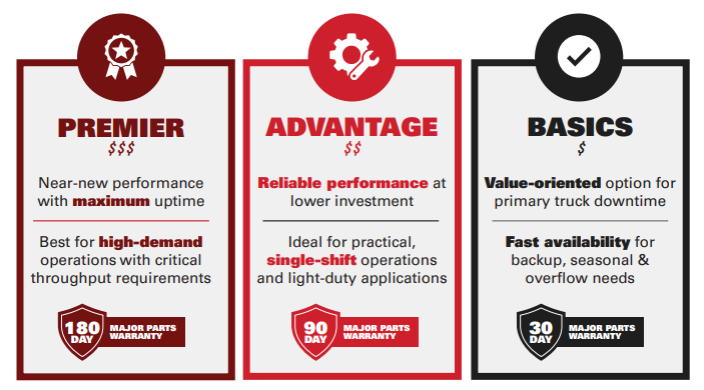
“No two operations are exactly alike, and we recognize that our customers have different throughput requirements, utilization levels, and capital priorities,” said Ryan Tiller, Vice President of Distribution and Fleet Services at Carolina Handling. “The expanded Renewed Program allows us to better partner with our customers by providing options that align with their specific operational goals. Whether they need like-new reliability, a balance of performance and investment, or equipment for occasional use, we can help them select the solution that best supports their business.”
Why Does the Traditional Used Forklift Model Fall Short?
A used forklift purchase is sometimes evaluated primarily on price. But the least expensive truck is not necessarily the lowest-cost option over its service life.
Unexpected downtime can interrupt production, affect fulfillment, create additional maintenance costs, and limit an operation’s ability to serve its own customers. At the same time, paying for a higher level of equipment than the application requires can tie up capital that may be needed elsewhere. The right decision depends on how the forklift will be used.
“With the multiple industries that we serve, there is no uniform solution,” Tiller said. “Expanding our core offering of used equipment helps tailor the right solution to the right customer and provide savings compared to new equipment.”
Carolina Handling’s tiered approach is designed to give customers clearer options rather than treating every used forklift and every application the same.
What Should You Consider Before Buying a Used Forklift?
Before comparing individual trucks, buyers should first understand the role the equipment will play in their operation. Important questions include:
- Will the forklift operate during one shift or multiple shifts?
- How many operating hours will it accumulate?
- What is the operational cost of downtime?
- Will it serve as a primary truck, be used only for light-duty applications, or is it needed as a backup truck?
- How long does the business expect to retain it?
- Is the priority near-new reliability, lower acquisition cost, or a balance of both?
- What service and parts support will be available after the purchase?
“Customers need to identify what is of the highest value, whether that is like-new reliability, cost, or a mixture of both,” Tiller said. “Setting these priorities will allow them to select the tier that best supports their operational goals.”
Equipment utilization also matters. A forklift suited for limited or occasional use may require more maintenance and experience greater downtime if it is placed into a demanding, multi-shift application.
“Seek to understand your operational throughput,” Tiller recommends. “Customers may find savings by understanding current and future equipment utilization.”
How Does Carolina Handling’s Expanded Renewed Forklift Program Work?
Carolina Handling’s expanded Renewed Forklift Program features three clearly defined tiers: Premier, Advantage and Basics. The tiers provide different levels of refurbishment and warranty coverage based on the equipment’s intended application and utilization.
All Renewed forklifts are refurbished at Carolina Handling’s Intralogistics Solutions Center in Easley, South Carolina, and receive quality and safety inspections before final order fulfillment. The program supports Class I through Class V forklifts, including electric and internal combustion equipment.
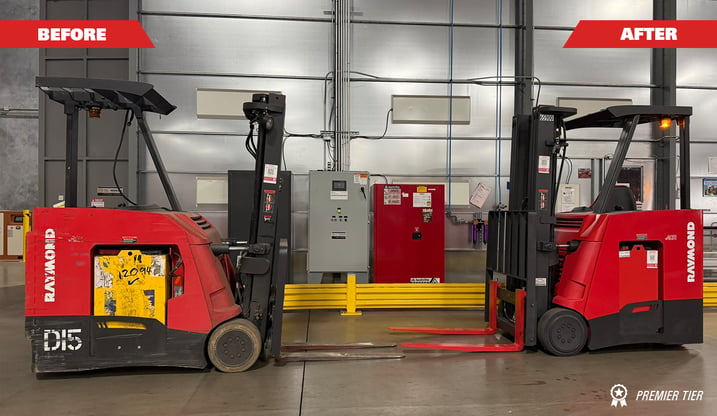 All Renewed forklifts are refurbished at Carolina Handling’s Intralogistics Solutions Center in Easley, South Carolina
“Our Renewed Program operates under the belief that equipment renewed in our Intralogistics Solutions Center provides long-term value to our customers that simple used equipment cannot,” Tiller said. “Our process helps extend the lifecycle of equipment and ultimately the return on investment for our customers.”
The tiered model gives buyers a more structured way to compare refurbished forklifts based on application, warranty coverage, and anticipated use.
When Is Carolina Handling’s Premier Tier the Right Renewed Forklift For My Needs?
Premier is designed for high-throughput customers and operations where equipment downtime carries a significant cost. It is the best fit for multi-shift applications, operations expected to exceed 1,500 hours of operator use a year, and facilities where equipment reliability directly affects production or customer service.
“Customers with a high opportunity cost for downtime, or with throughput requirements that demand reliability typically benefit from Premier,” Tiller said. “They want the reliability of new equipment without the cost or need for additional capital allocations.”
Premier includes:
- A full Renewed build
- A 180-day major parts warranty
- A 30-day full warranty
- The option to extend warranty coverage for up to one year at an additional cost
“Downtime can be costly not only to production value, but also to how our customers deliver value to their own customers,” Tiller said. “The peace of mind that comes with a 180-day warranty allows customers to focus on their operation instead of additional costs during the first six months of ownership.”
When Is Carolina Handling’s Advantage Tier the Right Renewed Forklift For My Needs?
Advantage is intended for single-shift operations and light-to-medium-duty applications. It provides an intermediate option for organizations that need dependable daily performance but do not require the build level associated with a demanding, multi-shift application.
“Advantage is an ideal pathway for a customer looking to scale through single-shift operations while allocating capital elsewhere,” Tiller said.
Advantage includes:
- A 90-day major parts warranty
- A 30-day full warranty
For many operations, the Advantage tier provides a practical balance between acquisition cost, reliability, and expected equipment use.
When Is Carolina Handling’s Renewed Basics Tier the Right Choice of Forklift For My Needs?
Renewed Basics is designed for limited-use applications such as backup, seasonal, and overflow needs.
“Our Basics line aims to support customers focused on cost, and those who value redundancy in their fleets at an efficient price point,” Tiller said.
Renewed Basics includes a 30-day major parts warranty and typically has a lead time of one to two weeks. By comparison, typical lead times for Premier and Advantage are four to six weeks.
Renewed Basics may also provide an alternative to rental equipment when a customer expects to retain the asset.
“Renewed Basics can help when customers prioritize capital acquisitions over operating expenses and need equipment quickly,” Tiller said. “They may anticipate a low total cost of ownership and want to retain additional equipment for future demand spikes.”
Why Does Warranty Coverage Matter When Buying a Used and Refurbished Forklift?
Warranty coverage helps buyers understand the level of protection associated with each Renewed tier. The warranty periods correspond with the build level and intended use of each option:
- Premier: 180-day major parts warranty and 30-day full warranty
- Advantage: 90-day major parts warranty and 30-day full warranty
- Basics: 30-day major parts warranty
“Our warranty lengths are matched to the level of build completed in our production facility and the value each tier provides,” Tiller said. “The 180-day warranty on our Premier build carries the confidence of reliability, while our Basics line provides our quality guarantee at an attractive price point.”
Buyers should also consider what happens after the warranty period. Carolina Handling offers breakdown support, scheduled maintenance, maintenance agreements, full-service agreements, local service support, and parts availability for Renewed equipment.
Why Does Service Support Need to Be Part of the Used Forklift Decision?
One of the most common mistakes in the used equipment market is evaluating the truck without evaluating the support behind it.
“A common mistake in the used market is not aligning after-sale service with the purchase,” Tiller said. “As essential as making the right purchase is, service response and quality are paramount.”
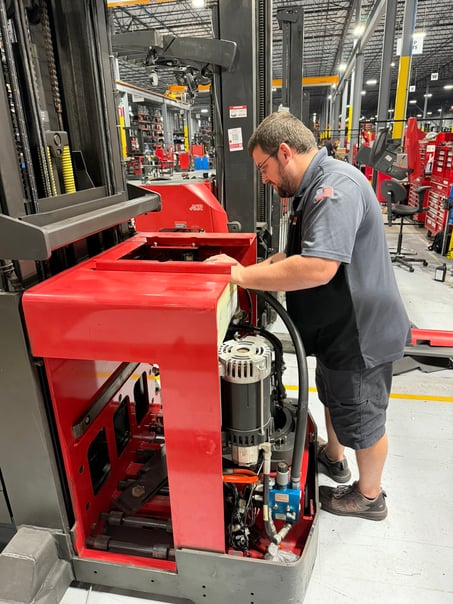 Carolina Handling supports Renewed forklifts after purchase through its local service teams.
A lower acquisition price can lose its advantage if the equipment is difficult to maintain, parts are unavailable, or service support is limited. Buyers should understand who will support the forklift, how warranty claims will be handled, and whether planned maintenance options are available.
Carolina Handling supports Renewed forklifts after purchase through its local service teams. Customers may also add scheduled maintenance or full-service agreements to Renewed equipment.
How Can Renewed Forklifts Support Capital Planning?
Equipment purchases can compete with other operational priorities, including automation, facility improvements, and efficiency initiatives. A refurbished forklift can reduce the initial investment compared with new equipment, but the financial value depends on selecting a build level that fits the application.
It’s also important to remember that if the application requires greater utilization and reliability, underinvesting in the truck may lead to additional downtime and maintenance expenses. The strongest approach is to match the investment to the work.
Why is the Used Forklift Decision Really an Application Decision?
New equipment and traditional used equipment are not the only considerations. Buyers should consider the level of refurbishment, intended application, warranty protection, expected utilization, and service support. A multi-shift distribution center and an operation looking for occasional backup capacity should not be expected to purchase the same forklift. That principle is at the center of Carolina Handling’s Renewed Forklift Program.
The right forklift is not necessarily the newest or the least expensive truck. It is the one that provides the right level of reliability, performance, support, and value for the work it is expected to do.
Frequently Asked Questions About Renewed Forklifts
What is a Renewed Forklift?
Short answer: A Carolina Handling Renewed Forklift is professionally refurbished to support a customer’s operational needs. The program helps extend the lifecycle of equipment and ultimately the return on investment for the customer.
How is a Renewed Forklift different from a typical used forklift?
Short answer: Carolina Handling’s Renewed Forklifts follow tier-specific build standards designed around different applications and utilization levels. Each truck also receives quality and safety inspections before final order fulfillment and includes warranty coverage based on its tier.
What are Carolina Handling’s three Renewed Forklift tiers?
Short answer: The expanded program features three clearly defined tiers:
- Premier: Built for multi-shift and high-throughput operations where downtime is costly
- Advantage: Designed for single-shift and light-to-medium-duty applications
- Basics: Intended for backup, seasonal, overflow, and other limited-use applications
Which Renewed Forklift tier offers the best value?
Short answer: The best value depends on the application. Premier supports higher throughput and applications where reliability is critical. Advantage provides a balance of cost and reliability for single-shift operations. Basics is a value-oriented option for backup, seasonal, and overflow needs.
What warranties come with Renewed Forklifts?
Short answer: Premier includes a 180-day major parts warranty and a 30-day full warranty. Advantage includes a 90-day major parts warranty and a 30-day full warranty. Basics includes a 30-day major parts warranty. Premier warranty coverage may be extended for up to one year at an additional cost.
What types of forklifts are available through the Renewed Program?
Short answer: The program supports Raymond Class I through Class V forklifts, including electric and internal combustion equipment.
Are batteries and chargers included with Renewed electric forklifts?
Short answer: Batteries and chargers can be included at an additional cost. Renewed Certified Power comes with a one-year warranty.
Can I finance a Renewed Forklift or trade in existing equipment?
Short answer: In-house and third-party financing are available for Premier and Advantage equipment. Carolina Handling also accepts trade-ins, with applicable value based on equipment type, age, and hours.
How long does it take to receive a Renewed Forklift?
Short answer: Typical lead times are four to six weeks for Premier, four to six weeks for Advantage, and one to two weeks for Basics.
Does Carolina Handling service Renewed Forklifts after the sale?
Short answer: Yes. Carolina Handling supports breakdown and scheduled maintenance needs after purchase. We encourage our customers to add scheduled maintenance agreements or full service agreements to their Renewed equipment. Local service remains available after the warranty expires.